Here is an interesting article about the future of Science after SATs in the TES.
Showing posts with label Science. Show all posts
Showing posts with label Science. Show all posts
Friday, 22 May 2009


Monday, 11 May 2009
Science SATs
 Science Paper A
A good variety of questions (humans, investigations, forces, plants, solids/liquids/gases, light and electricity). The questions made a lot of use of diagrams and pictures.
Science Paper B
Lots of reading in this paper making it more demanding. I wasn't too keen on the Heart Rate question, nor the Shadows and Space where I found the questions a little confusing, with unusual contexts.
I can't believe that there was nothing on animals, sound or micro-organisms.
Any thoughts?
Use Monittor.com to read about #SATs.
Saturday, 9 May 2009
Science SATs to be scrapped
It's hard to believe the timing of the news about Science SATs. In our school we've just spent five school weeks revising for the Science SATs, and just a few days before the children get stuck in, they get the news that next year's Science SATs won't even take place. How frustrating for this year's children! I'm sure it's going to have a negative effect on this year's Science results, too. After all the children are now bound to think that they are pointless. What's the point - they are about to be scrapped!
Don't get me wrong, I'm all for the SATs being scrapped altogether, but once again Ed hasn't got the Balls to do the right thing and has only agreed to drop one of the three subjects. Teacher assessment clearly gives a better representation of a child's ability. But, for the time being, apparently tests give a better indication of standards in English and Maths.
If the SATs are set to continue, I wonder how long it will be before an ICT SAT is introduced...
The Guardian reports:
Ed Balls, the education secretary, today backed a drive to improve teacher assessment to the point where it is robust enough to replace national Sats tests in England.
Accepting a report from an expert group on assessment, he announced that Sats tests in maths and English for 11-year olds would be retained, but tests in science would be scrapped in favour of teacher assessment.
The review argued that while the current tests were beneficial and gave parents objective information, teacher assessment provided a richer picture of children's learning, and it appeared to open the way for scrapping Sats in the long term. This type of national testing was dropped in
Wales and is not used in Scotland.
The group, including the former chief inspector Sir Jim Rose, urged the government to "invest in, strengthen and monitor the reliability of teacher assessment, to judge whether a move away from externally marked national tests might be viable at a future date".
Rose told a press briefing: "Clearly if you had a situation where you had teacher assessment that was so robust that you were confident the information it was delivering was as good, or better, than national testing, then by God wouldn't you go for it? Meanwhile, you would want to run both together, wouldn't you? We want a belt and braces job."
But retaining Sats in the short term sets the stage for a confrontation with two of England's biggest teaching unions, the National Union of Teachers and the National Association of Head Teachers, who are to ballot on boycotting next year's tests if they are not scrapped.
A move towards teacher assessment has already happened for seven- and 14-year olds, and will now take place in science at the end of primary school. Single-level tests – taken by children when the teacher thinks they are ready – also involve more teacher input. A pilot study of these tests in 400 schools has been extended for a third year, and they could form part of the eventual replacement for Sats.
League tables based on Sats results will not be abolished, but Balls accepted the expert group's recommendation that report cards sumarising a wider range of information on each school's performance should be developed.
Tuesday, 26 August 2008
Amazing Microbe Hunters
This site is great for researching scientists who studied microbes. Very useful for the Micro-organisms science scheme of work which we are starting the year with next week!
Monday, 18 August 2008
Printable paper
If you ever need a sheet of graph paper in a hurry, why not use Printable Paper.net, a handy website. There are lots of different papers you can download to print.
Sunday, 22 June 2008
Science is uninspiring
According to the TES, the national curriculum and the testing regime lead to boring and repetitive science lessons. Ofsted found that too much time was spent preparing pupils for exams instead of allowing children to do hands-on experiments.
Primary teachers, in particular, lacked confidence, relying too heavily on textbooks and worksheets, according to the report, which looked at lessons in 90 primary and 105 secondary schools. There was limited training for teachers to enhance their expertise in science.
Christine Gilbertm the chief inspector, said: "Science is a fascinating and exciting subject, yet for many pupils it lacks appeal because of the way that it is taught."
Saturday, 12 April 2008
Test preparation turns pupils off science
The TES writes that pupils in England are being 'turned off science' by months of test preparation in their last year of primary school. A report by the Wellcome Trust found that practical work was often marginalised in the spring term of Year 6 becuase of the foucs on revision.
The study says, "Test preparation in its current form contributed little to pupils; understanding. The sole purpose was to equip pupils with sufficient factual knowledge and scientific terminology to answer written questions on science test papers."
One teacher reported sometimes having to stop pupils' investigations mid-flow becuase they had covered all the test objectives and needed to move on to more revision. Some staff, however, said testing was good for some pupils. One said, "Behaviour improves and they work hard."
Test preparation is not the only reason schools find it difficult to focus on practical experiments. 34% of those surveyed complained about a lack of resources, while 23% bemoaned a general lack of time.
I agree with the findings of this completely. Year Six teachers know that in order to do well in the Science SATs, it requires a few weeks of abandoning practical work to focus on theory. Behaviour improves because of the variety of revision to keep the children interested. How can we teach science more practically without the resources and technician-help available at high schools?
Wednesday, 19 March 2008
Darwin's Footsteps
 Darwin's Footsteps is an interactive game where pupils can follow Darwin’s voyage of discovery around the world. This would be very useful when learning about how animals and plants are adapted to their environments.
Tuesday, 18 March 2008
The Science of Rotting
 The Science of Rotting is a website that... well it's just what it sounds like - photos of lots of items rotting away!! Great for a study of micro-organisms!
Sunday, 16 March 2008
Transition projects more important in Science
According to a report in the TES, projects aimed at improving pupils' transition between primary and secondary schools are more important for science than maths or English, according to a new study.
The report also found that, to be successful, the schemes should run from Year 5 to Year 8, rather than just in Year 6 and Year 7.
Martin Braund, a lecturer in science education at York University, examined the drop in achievement in science between primary and secondary school. He found two in five pupils failed to make the progress in KS3 suggested by their results in KS2. This is four times the drop in maths and five times that in English. And classroom observation indicates that, between 11 and 14, pupils' concentration levels decline more in science than in English or maths.
Mr Braund suggests that this may be becuase secondary teachers often introduce scientific terms and concepts that pupils have already covered at primary level. Repeating the same work, with no additional challenges, merely alienates pupils. And, while secondaries often appoint transition co-ordinators in maths and English, this rarely happens in science.
I find this all a little surprising. Whilst English and Maths in high school should offer more of a challenge to pupils than in in primary school, the subjects do not particularly alter. Writing is still writing, reading is still reading and maths is still maths - allbeit at a higher level. But science? Science, as I thought, is the one subject that should be dramatically different in high school. High schools have incredible facilities - Bunsen burners, gas chambers, electricity boxes, chemicals, metals, etc - all of which primary schools simply do not have the facilities to offer. To me, the transition in science should be an amazing one - to go from the uninspiring QCA schemes of work offered in Year Six to the possibilities offered by specialist teachers should be a truly memorable experience.
Saturday, 23 February 2008
Animal Adaptations display
 As part of our science unit on Animal Adaptations the children made paper mache animals and researched to find out how they are adapted to their environment. The practical aspect brought this unit alive and the research they completed was excellent as a result.
Over the next year I will be buying lots of stuffed animals to avoid the long process of making them. The display will be just as effective!
Saturday, 22 December 2007
Spuds You'll Like
 Primary schools are being encouraged to pant their own potatoes next term, as part of a national project. To mark the international year of the potato in 2008, the British Potato Council is asking pupils to chip in and grow their own. All schools that register before February 8th will be given free seed potatos and a £5 voucher towards compost. The council has compiled a range of online education resources.The school that grows the most potatoes will be given a digital camera.
Sunday, 11 November 2007
Energy Experience
 The E.On Experience is a lively, interactive online resource designed to help teach children aged 5-16 about energy. KS2 children can visit Energy Town where they will learn about the different types of energy we use, as well as their advantages and disadvantages, and effects on the world. There is also a free classroom pack which can be ordered free of charge from the site.
Wednesday, 31 October 2007
Mentos + Diet Coke = Fountain!!
The "Mentos fountain" is created by dropping soft mints into bottles of Diet Coke. Steve Spangler turned this really cool trick into an internet sensation on Youtube. There is a website where you can find out how to use this in the classroom. Although the resources are aimed at Y7 & 8 I don't plan to let an amazing trick like this slip by without trying it with my class! Also check out Steve Spangler's website.
Saturday, 13 October 2007
Show.me.uk
 Show Me is a new website for KS1 and KS2. It is full of educational games, interactive activies, teaching ideas and resources created by museums and galleries. It will be very useful when planning for History, Science and Art topics in particular.
Monday, 14 May 2007
SATs Science Tests
The SATs week kicks off, as usual, with the Science Tests. I'm always pleased that Science is first as our children tend to find them okay, and it gives them a confidence boost for the rest of the week.
The tests were actually a little unusual. Some aspects of Science were not covered, for example, micro-organisms, yet somethings featured in both papers, like Earth and Beyond.
Overall, the tests were not too bad and the children were happy.
Please give any comments about the Science SATs.
Wednesday, 9 May 2007
Cluster Science Group
Our local high school, Shavington, have become a Science and Maths Specialist College. Part of their funding needs to be spent in the community to foster links with primary schools. The Cluster Science Group have, therefore, decided to purchase science resources which all schools are able to borrow.
This evening we went to see some of the items and I was well impressed. After initially writing a list of items we could use, I quickly realised that we could borrow everything. I'm very looking forward to trialling the new dataloggers!
Wednesday, 28 March 2007
Marine conservation roadshow
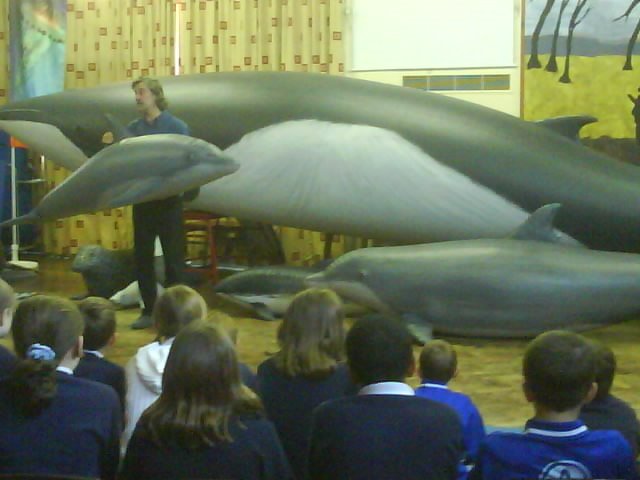 Today the Marine Conservation Society visited our school with the Cool Seas Roadshow! The presentation featured life-sized marine creatures (whales, dolphins, sharks, turtles and seals). Demonstrations were delivered to each year group, and the children found out about lots of different marine wildlife. Each child was given an action pack booklet and each class received a poster. Resources are available online at the Cool Seas website.
The children found it really interesting!
Saturday, 24 March 2007
Naked Scientists!
Today's Daily Mail features an article about the Naked Scientists website which is devised by Chris Smith and Dave Ansell, two scientists from Cambridge University. Included in the article are eleven experiments, such as turning bread into suagr, making sugar glow in the dark, creating electric slime and making a forcefield.
I plan to use a few of these experiments in the run up to the SATs - something to keep the children excited about the subject!
More experiments and a podcast are available on the website.
Monday, 22 January 2007
Micro-organisms
We have concluded our look at this topic today. I have really enjoyed teaching this, this year. It's hard to believe how much we crammed in, and yet there's a lot more that we could add. The children took a tour of our school kitchen to look at food safety and had a visit from a GP to talk about bacteria, viruses and fungus. The children designed posters to show good food safety and to show what they learned about useful micro-organisms. They grew yeast and investigated the best conditions to grow mould. The children studied various website.
Here are some of the sites we used:
Foodlink
BBC Science Clips
Microbe Zoo
Bug Investigators
What are bacteria?
Composting
Food Standards Agency
Cells Alive!
Next year we plan to set up our own compost. The one thing big missing this year is a good video about micro-organisms. Does anyone know of one?
Subscribe to:
Posts (Atom)